Regulation · · 3 outlets
1 Billion Euro transaction highlights ECB warning on tokenized asset market control
The European Central Bank president, Christine Lagarde, issued a caution to Brussels, stating that the opportunity to establish a single market for tokenized assets might close permanently if…
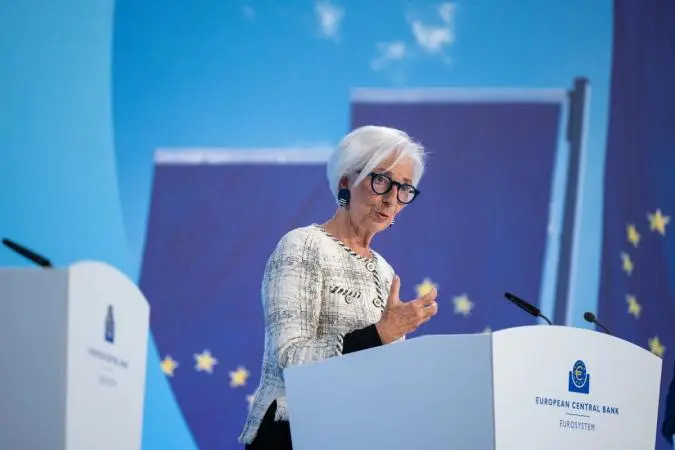
The European Central Bank president, Christine Lagarde, issued a caution to Brussels, stating that the opportunity to establish a single market for tokenized assets might close permanently if legislators delay agreeing on regulations. Her apprehension stems from the possibility that competing blockchain platforms could diverge into isolated silos before rules are established, making future integration unfeasible. Lagarde presented this argument during a speech on November 20, 2026. Her core assertion was that the necessary infrastructure and corresponding legislation must advance concurrently, because a single market cannot materialize from one element alone. She stated, "With the right framework, tokenization offers a chance to build a genuine single market in digital assets, integrated from the start."
The ECB has already deployed hardware for this purpose; its Pontes platform became operational on September 21, 2026, facilitating the settlement of wholesale tokenized securities transactions utilizing central bank money. This specific detail carries significant weight because settling using central bank money ensures the final step of a trade occurs in the most secure form of the euro available, rather than relying on commercial bank liabilities or private stablecoins. Pontes interfaces with the existing Eurosystem infrastructure, and its participants include major financial institutions such as Deutsche Bank and Santander, alongside distributed ledger operators like Clearstream. Nevertheless, Lagarde emphasized that mere technical plumbing is insufficient. While shared settlement mechanisms are beneficial, the market will still become fragmented if the legal treatment of tokenized assets differs across the bloc.
From the perspective of traditional finance, the tokenized asset market remains relatively nascent; it reached roughly €23 billion globally as of March 2026, marking a fivefold increase from the prior year. Pontes has already processed at least one major transaction: in early November 2026, the European Stability Mechanism settled a digitally native bond valued at €1 billion on the platform. The ECB's objectives extend further, with full operationalization of Pontes, incorporating more advanced functionalities, slated for 2028. Furthermore, a separate undertaking, known as the Appia project, is currently in progress, and the central bank is planning to deploy its own capital into tokenized securities.
Lagarde's warning resonates with a long-standing concern within Europe: the difficulty the EU has faced in transforming its 27 national financial systems into a structure resembling a unified capital market. Tokenization presents a new iteration of this enduring issue, as disparate blockchain platforms can utilize varying technical standards, legal structures, and settlement models. In the initial stages, resolving these differences is inexpensive, but once billions of euros and years of established institutional processes are built upon them, these differences become deeply ingrained. Therefore, her message centers on the correct timing: rules must be agreed upon while the market is still valued in tens of billions, not after it has reached trillions.
For institutional participants, the ECB is signaling a commitment to the advancement of tokenized finance, having constructed the necessary operational channels to support it. Banks such as Santander and Deutsche Bank are already integrated. Issuers contemplating placing bonds onto the blockchain will be observing whether EU legislators devise a cohesive framework or if national approaches diverge. The €1 billion transaction by the ESM demonstrates the system's capacity for large-scale operations. For the wider crypto sector, the tokenization of real-world assets has been a prominent narrative, and a central bank actively developing such a system provides a degree of validation. Concurrently, the ECB's implementation utilizes central bank money and wholesale infrastructure with regulated participants. The critical factors to monitor are clear: first, whether EU lawmakers address legislation within a timeframe matching Lagarde's sense of urgency; second, whether more sovereign and supranational issuers follow the ESM onto Pontes; and third, how the ECB's own investments in tokenized securities will materialize as the platform approaches its 2028 completion goal.
Why it matters
This signals that while central banks are building the technical rails for tokenized finance, regulatory fragmentation poses a significant threat to market unity. Institutional players and issuers will closely watch EU lawmakers to see if a unified legal framework is adopted before platforms become entrenched silos.
Reported by CoinDesk, Crypto Briefing and CoinTelegraph.