ethereum · · 2 outlets
Ripple’s RLUSD Wins Moody’s Rating as XRP Faces a Bigger Question: Who Captures the Value?
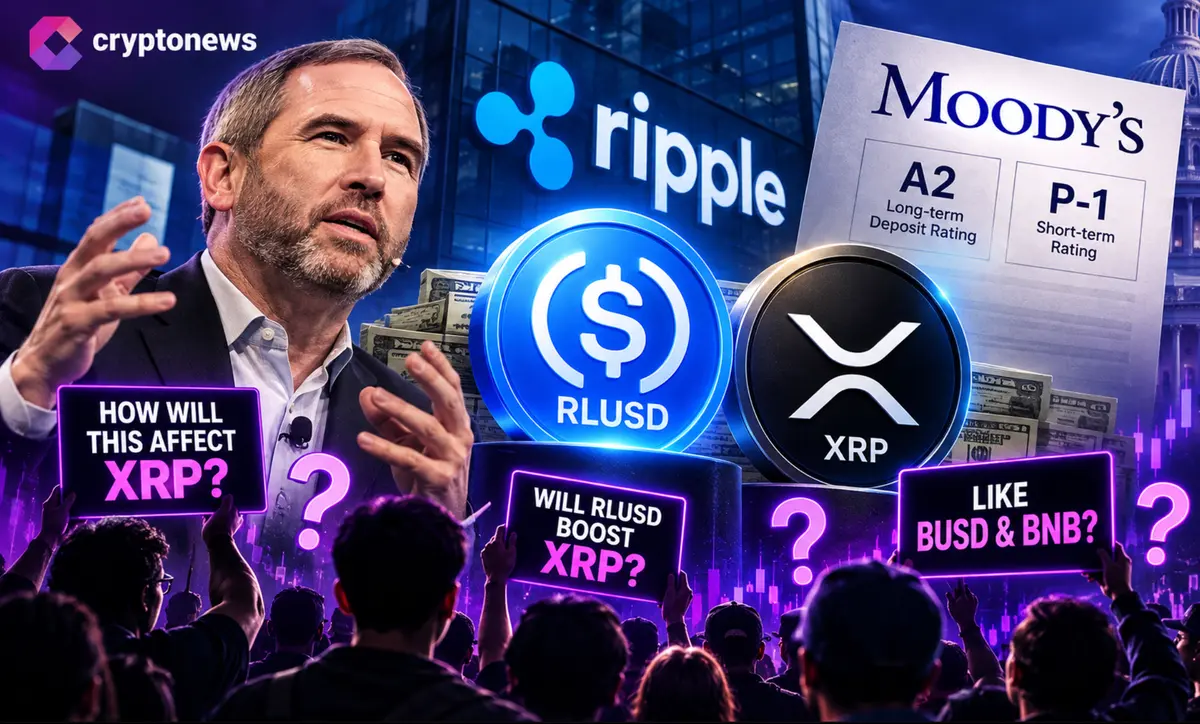
Ripple’s RLUSD received a Moody’s A2 rating, coinciding with Ripple gaining OCC trust-bank approval. This raises the question of whether XRP can benefit from stablecoin expansion, similar to BNB’s trajectory.
Moody’s assigned RLUSD an A2 long-term rating and a P-1 short-term rating, the highest possible under its new stablecoin framework. Jack McDonald noted on October 28, 2026, that "RLUSD is the first stablecoin to have ever received an investment-grade…"
This rating accompanies Ripple’s final approval to operate a national trust bank under the Office of the Comptroller of the Currency (OCC). This bank will manage RLUSD reserves and offer institutional custody services, while Bank of New York Mellon remains the primary reserve custodian for the stablecoin.
The Moody’s rating provides a formal credit assessment that institutional risk teams can use in their evaluations. RLUSD will continue to be issued by Standard Custody & Trust Company, its New York-regulated subsidiary. The trust bank will provide fiduciary digital-asset custody services, manage segregated reserves, and act as collateral trustee. Ripple detailed these approved activities on October 26.
The potential for XRP hinges on institutional actions following RLUSD adoption. While every transaction on XRP Ledger requires XRP for network fees, and accounts need XRP for reserve requirements, this alone may not create significant demand.
A larger opportunity exists in cross-currency payments. Institutions could utilize XRP as a bridge asset when converting currencies, instead of routing every transaction through traditional intermediaries or dollar stablecoins. This allows RLUSD to settle directly, bypassing the need for an institution to buy XRP for the full payment amount.
On Ethereum, transfers do not require XRP for gas. Therefore, RLUSD’s market cap could increase substantially without causing a proportional demand spike for XRP. The bullish outlook strengthens if stablecoin adoption also deepens XRP liquidity, increases bridge transactions, and brings new institutional trading activity.
Binance’s historical BUSD–BNB model shows how a stablecoin can support a broader crypto business. BUSD provided dollar-denominated liquidity, and BNB served multiple roles across Binance’s exchange and blockchain infrastructure. BNB earns utility via network fees and trading-fee discounts, plus a supply-reducing token-burning mechanism.
Ripple’s situation differs; RLUSD offers dollar stability, whereas XRP functions as the native asset of the XRP Ledger and a potential cross-currency bridge. Ripple might achieve a comparable value-capture loop if institutional RLUSD uptake increases the demand for XRP liquidity.
If RLUSD’s market cap grew tenfold, from $2.5 billion to $25 billion, this would signify a much larger stablecoin business for Ripple, but it would not automatically mean a tenfold rise in XRP’s price. The final result depends on network activity, integration levels, and the proportion of payments using XRP.
The XRP price has moved above $1.30, trading at $1.32, showing a 2.35% intraday gain, which aligns with Moody’s investment-grade rating for RLUSD. Concurrently, XRP held by whales has reached its highest level since 2022.
Reported by cryptonews.com and coingape.com.