Bitcoin · · 2 outlets
$14.2B stablecoin withdrawal drives crypto crash, Bitcoin below $69K on Nov 13
Amidst $14.2B in stablecoin withdrawals, ETF selling, and turmoil surrounding Nvidia, Bitcoin, Ethereum, and XRP are falling as cryptocurrency liquidity diminishes.

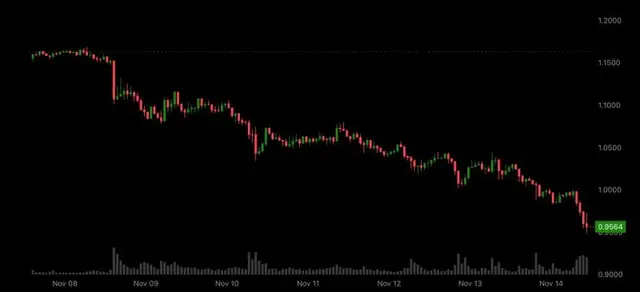
The market experienced another significant downturn on Friday, November 13, with several major altcoins registering losses exceeding 6%, and Bitcoin dropping beneath the $69,000 mark. Market figures from crypto.news indicated that Bitcoin traded near $68,388, reflecting a 7% decrease across a 24-hour span, whereas Ethereum decreased by 6.2% to reach $1,922. Solana saw a 5.9% decline, settling at $78.30, while BNB fell 6.8% to $631, and XRP experienced a 4% reduction, reaching roughly $1. This selling pressure stems from a $14.2 billion reduction in the supply of stablecoins, ongoing withdrawals from crypto investment funds, and renewed uncertainty regarding Nvidia's leadership. Additional strain has been introduced by Middle East tensions and forced liquidations.
Investors are confronting several evolving situations that impact the demand for riskier assets as this latest crypto market collapse occurs. The announcement of Jensen Huang, Nvidia's CEO, stepping down on November 12 caused unease among technology stocks, especially those linked to artificial intelligence infrastructure. Following this declaration, Nvidia's stock price declined, and selling pressure mounted on other companies involved in AI. During this same timeframe, major altcoins and Bitcoin weakened. Previously, crypto.news had noted that Bitcoin had already breached $73,000 as the leadership issue at Nvidia developed. Furthermore, stronger indicators of US inflation have heightened the likelihood that the Federal Reserve might raise interest rates again in December. The strengthening dollar, coupled with rising Treasury yields, adds pressure to investments sensitive to borrowing costs. Geopolitical instability persisted on Friday after Iran's Revolutionary Guard Corps claimed responsibility for hitting a US early-warning radar installation located in Bahrain. This reported strike followed an alleged assault on a telecommunications tower situated in southern Iran, though neither US nor Bahraini authorities had immediately verified the Iranian claims.
Separately from the Friday market movements, Glassnode, a firm specializing in blockchain analytics, pinpointed a persistent decrease in capital available for crypto trading. In its November 11 research report, Glassnode observed that the stablecoin supply had shrunk by $14.2 billion over the 30 days leading up to November 9. This reduction represents the largest contraction since June 2022, a period when crypto markets saw significant outflows following the downfall of Terra. Stablecoins, including USDT and USDC, enable traders to hold dollar-linked assets before purchasing cryptocurrencies such as Bitcoin and Ethereum. When investors exchange these stablecoins for dollars, the circulating supply diminishes, thereby lowering the quantity of dollar-linked funds within the crypto market. Glassnode issued a caution that this decline provides "less fuel for a rally." The research group also identified ongoing outflows from US spot Bitcoin ETFs and subdued buying activity on Coinbase as additional indicators of weakening appetite. Its report indicated that Bitcoin was trading below the average purchase price of recent investors, which hovered near $75,600. Nevertheless, Glassnode noted some purchasing activity among wallets possessing between 100 and 10,000 BTC, even as both smaller and larger investor groups continued to diminish their holdings.
Institutional cryptocurrency investment products have registered continuous withdrawals during this market downturn. Glassnode reported that US spot Bitcoin ETFs experienced losses totaling around $1.6 billion across 20 trading sessions. More recent data from Farside Investors demonstrated $299.8 million in Bitcoin ETF withdrawals on November 11, which included $269.7 million from BlackRock's IBIT. Similar selling was seen in Ethereum funds; US spot Ether ETFs lost $144.8 million during that same session, with BlackRock's ETHA contributing $129.8 million. These withdrawals illustrate investors scaling back their exposure through regulated instruments while Bitcoin and Ethereum continue trading below significant price thresholds.
Selling pressure has extended into the derivatives market. CoinGlass data revealed $1.23 billion in crypto liquidations across a rolling 24-hour period. Bitcoin accounted for approximately $677.5 million of these, while Ethereum represented another $249.8 million. The majority of the positions that were liquidated belonged to traders who were wagering on price increases. Data from crypto.news shows losses across major digital currencies, with tokens focused on privacy being among the hardest hit. Monero fell 11.1% to $510.71, and Zcash dropped 9.1% to $892.51, while Dogecoin lost 6% to $0.06323, and Chainlink declined 4.2% to $9.67. Other prominent assets, such as Avalanche, Uniswap, Aave, Hedera, and NEAR, recorded decreases of roughly 6% or greater in subsequent market readings.
Despite the selling, Glassnode's November 11 research pointed out considerable Bitcoin purchase orders existing between $68,000 and $72,500 on primary exchanges. The firm stated that buy orders had surpassed sell orders within a 5% range of Bitcoin's trading price since November 5, although exchange orders are susceptible to being canceled prior to execution. Glassnode identified the range of $62,000 to $66,000 as an area where substantial Bitcoin holdings were previously acquired, while its longer-term assessment placed the June low near $58,500.
Why it matters
This downturn reflects broader liquidity issues in the crypto market, driven by stablecoin withdrawals and ETF selling. Investors should watch how these capital outflows affect future demand for riskier digital assets amidst macroeconomic uncertainty.
Earlier coverage
Reported by crypto.news and CoinGape.